
We independently research product reviews. We may earn a commission when you shop through our links. Learn More
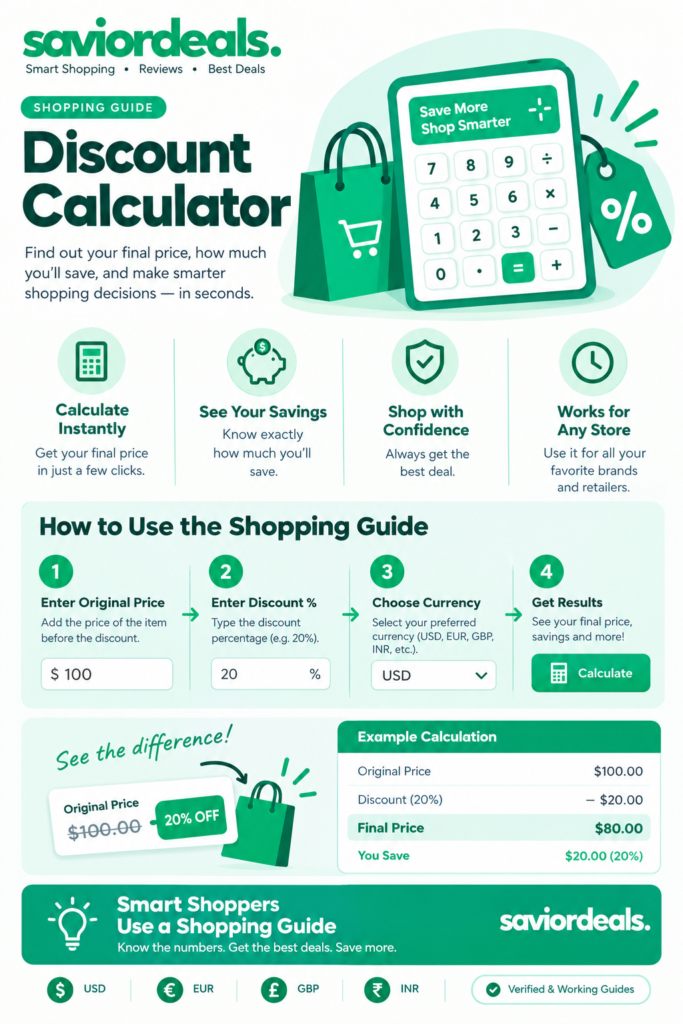
Retailers design markdown tags—like “40% OFF” or “Take an Extra 15% at Checkout”—to encourage fast purchase decisions. Doing quick mental math on a store floor often leads to overestimating your actual savings or overspending your budget.
Our free discount calculator eliminates the guesswork. Input your original price and discount percentage to instantly view your exact final price, total dollar savings, and sales tax adjustments.
Calculating markdown prices takes seconds. Follow these three steps to audit your retail or e-commerce deals before checking out:
79.99).25 for a 25% markdown). You do not need to type the % symbol.Understanding how markdown formulas work ensures you never fall for misleading retail pricing strategies. You can also explore CUEMATH’s guide on calculating discounts for a deeper mathematical breakdown.
To calculate a percentage discount manually, multiply the original price by the discount percentage (converted into a decimal), then subtract that number from the original price:
1. Discount Amount Formula:
Discount Amount = Original Price × (Discount Percentage ÷ 100)
2. Final Price Formula:
Final Price = Original Price − Discount Amount
If a pair of running shoes originally costs $120.00 and is marked 30% off:
Your final price is $84.00, and you save $36.00.
Retailers frequently offer competing promotions—such as flat-rate dollar coupons versus storewide percentage discounts. Running the exact numbers reveals which deal delivers true savings.
| Scenario / Item | Regular Price | Promo Offer A | Promo Offer B | Winning Deal |
|---|---|---|---|---|
| Grocery Cereal Box | $5.00 vs $4.50 | 20% Off ($5.00 Box) = $4.00 | 10% Off ($4.50 Box) = $4.05 | Promo A ($4.00) |
| Winter Jacket | $90.00 | 15% Storewide Off = $76.50 | $20 Off Coupon = $70.00 | Promo B ($70.00) |
| Ergonomic Desk | $250.00 | 30% Off Clearance = $175.00 | $60 Flat Rebate = $190.00 | Promo A ($175.00) |
Imagine you are purchasing a $90.00 jacket. The store offers two promotional paths:
Using the discount calculator to test both options shows that 15% off $90 yields a $13.50 discount (final price: $76.50). Taking the $20 flat coupon reduces the final price to $70.00. Choosing the flat coupon saves you an additional $6.50.
Stores use specific pricing psychology tactics to make sales appear larger than they are. For more expert strategies on smart purchasing, check out our guide on Best Shopping Tips: How to Save Money and Shop Smart.
1. Inflated “Original” List Prices (Anchor Pricing):
Retailers sometimes raise an item’s base price right before a major holiday sale. A “50% OFF” deal on an artificially marked-up $200 item leaves you paying $100—the exact regular price of the item a month earlier.
2. Stacked Discount Misconceptions:
If an item is “20% off” with an “extra 10% off at register,” that does not equal 30% off. The extra 10% applies to the already discounted price, yielding an actual total savings of 28%.
3. High Shipping Costs Eating Your Savings:
An online item marked 60% off can lose its financial edge if the seller adds $15 in mandatory shipping fees. Always enter the total landed cost into your financial budget before checking out.
The SaviorDeals Discount Calculator supports percentage markdowns, fixed dollar rebates, and Buy-One-Get-One (BOGO) deal calculations across multiple currencies.
Bookmark this tool on your mobile browser to audit retail pricing on the go, avoid impulse purchases, and verify that every sale tag delivers genuine value. To learn more about calculating percentage markdowns professionally, consult Indeed’s tutorial on how to calculate a discount.
Most standard discount calculations compute pre-tax savings. To find your total register price, multiply your final discounted price by your local sales tax rate (e.g., a $50 final price in an 8% tax zone equals $54 total).
It depends on the base cost of the item. On higher-priced items, a percentage discount usually yields greater savings. On lower-priced items that barely hit a minimum spend threshold, flat-rate dollar coupons often save more.